The Future Is Talking: Computational Models, Synthetic Biology and the Next Frontier of Cell Communication
Your Cells Have Better Group Chats Than You Do
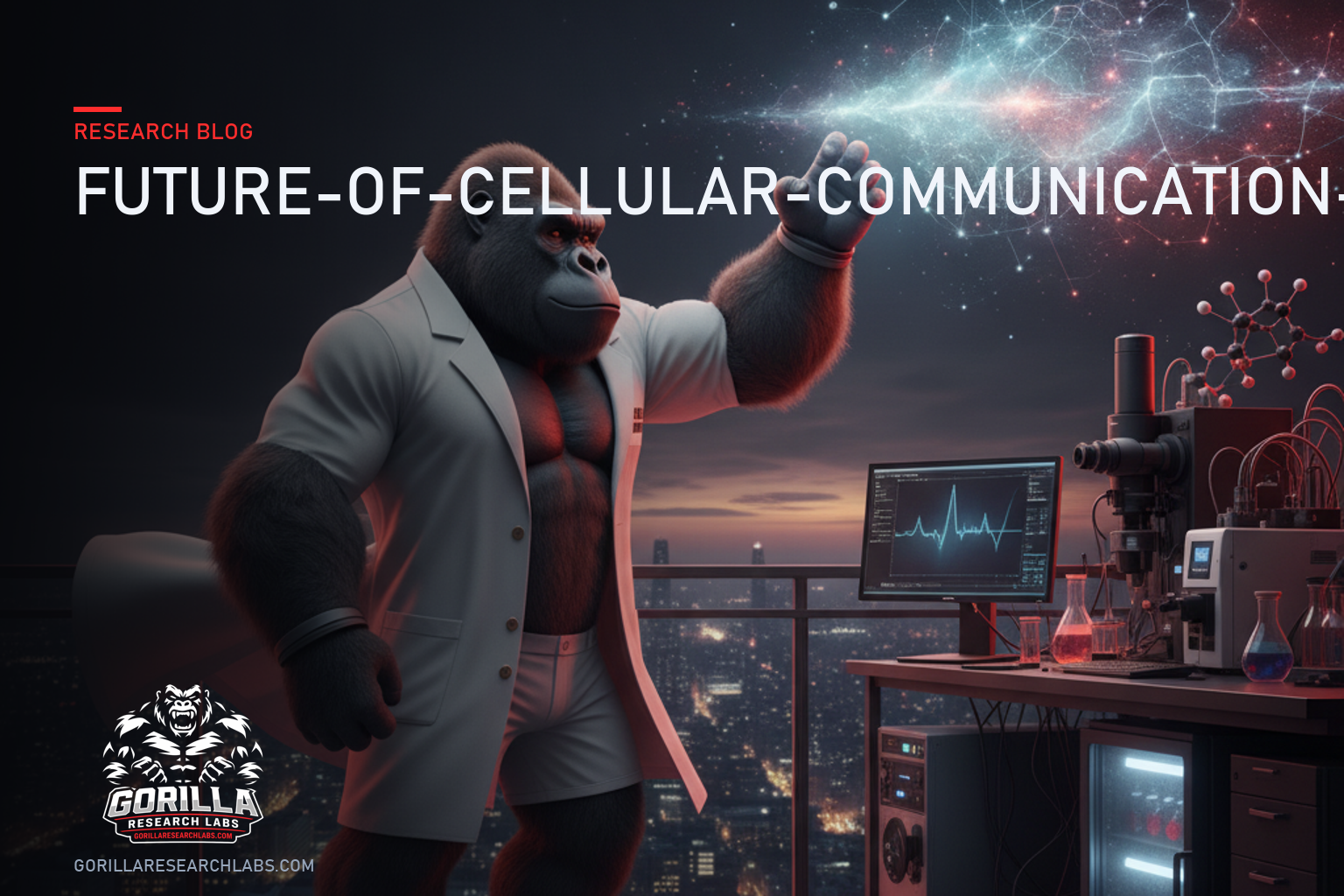
Picture the Gorilla Professor standing at the edge of a glowing lab balcony, lab coat snapping in the wind, one massive charcoal-grey arm raised to the horizon in a slow, deliberate flex. He is not posing (okay, he is a little). He is gazing at the future of cellular communication research , and friend, it is loud out there. Trillions of cells, chattering nonstop, running the most sophisticated messaging network ever built. No dropped calls. No "sorry, you cut out." Just pure, relentless biological signal. We used to study this conversation one whisper at a time. That era is ending. Buckle up.
The Network Was Always There. We Just Learned to Listen.
For decades, biology looked at one receptor, one messenger, one door at a time. It worked, but it was like trying to understand a stadium by interviewing a single fan. The real story is the network : cells firing signals into a crowd, receptors lighting up like switchboards, feedback loops answering back before the first message even lands. Cellular signaling isn't a straight line. It's a web. Push one node and eleven others twitch. That complexity used to be a nightmare. Now it's the whole point, and researchers finally have the tools to map the chatter as a living, breathing system instead of a pile of disconnected notes.
Receptor Dynamics: The Doors Never Stop Moving
Here's the part that makes the Professor grin. Receptors aren't static keyholes waiting politely for a key. They flex, cluster, recycle, change shape mid-conversation, and sometimes team up to say something neither could say alone. Studying receptor dynamics means catching molecules mid-handshake, which is roughly as easy as photographing a hummingbird's opinion. And yet, imaging and modeling are getting scary good at it.
Enter the Computer (Flex Intensifies)
You cannot brute-force a trillion-conversation network with a whiteboard. This is where the future gets genuinely thrilling. Computational modeling lets researchers build the messaging web in silico, run it, break it, and watch what happens without touching a single dish. • Protein-interaction mapping — charting who talks to whom across thousands of molecular players, turning a tangle into an actual map. • Systems models — simulating how a signal ripples through the whole network instead of guessing from a single node. • Predictive dynamics — testing "what if we nudge this one loop?" as a hypothesis on a screen before it's ever a hypothesis in a lab. • Structure prediction — folding proteins in software fast enough that the bottleneck is now imagination, not computation. The Professor's take: the microscope showed us the players. The model finally shows us the game.
Synthetic Biology: From Reading the Language to Writing It
If computational modeling is learning to read the cellular conversation fluently, synthetic biology is learning to write it. Researchers are designing signaling circuits, engineering communication pathways, and building biological logic the way engineers once built radios — piece by piece, testing what the language of cells can actually be made to say. That's the frontier the Professor is squinting at on the horizon. Not just eavesdropping on cellular communication, but understanding it deeply enough to sketch new sentences in it — all inside the lab, all as pure scientific exploration.
Why This Is Genuinely Exciting
Every one of these threads — networks, receptors, mapping, modeling, synthetic circuits — is converging. Wet-lab data feeds the models. The models sharpen the next experiment. Synthetic designs test whether we truly understood the wiring. It's a feedback loop about feedback loops, which is either poetic or deeply on-brand for a field obsessed with signaling. The next decade of cellular communication research won't be about one breakthrough molecule. It'll be about finally hearing the whole conversation at once — and that's a horizon worth flexing toward.
The Responsible Closer (Read This Part, Champ)
The Gorilla Professor lowers his arm, adjusts his goggles, and gets serious for one beat. Everything above is science made fun for education and curiosity only . It's a celebration of research directions and the beautiful complexity of how cells talk — not advice, not a protocol, and not a claim about any product or outcome. All laboratory work stays exactly there: in the laboratory, for research use only, never for human or animal administration. Now go tell someone their cells have a better group chat than they do. The Professor already flexed on it.
References
- NCBI Bookshelf — Molecular Biology of the Cell: Signaling
- PMC — Cell signaling pathways and receptor biology
Authoritative sources cited for research context. Research use only — not medical advice.