Lost in Transduction: How Cells Turn Outside Signals Into Real Action
Runners, take your marks
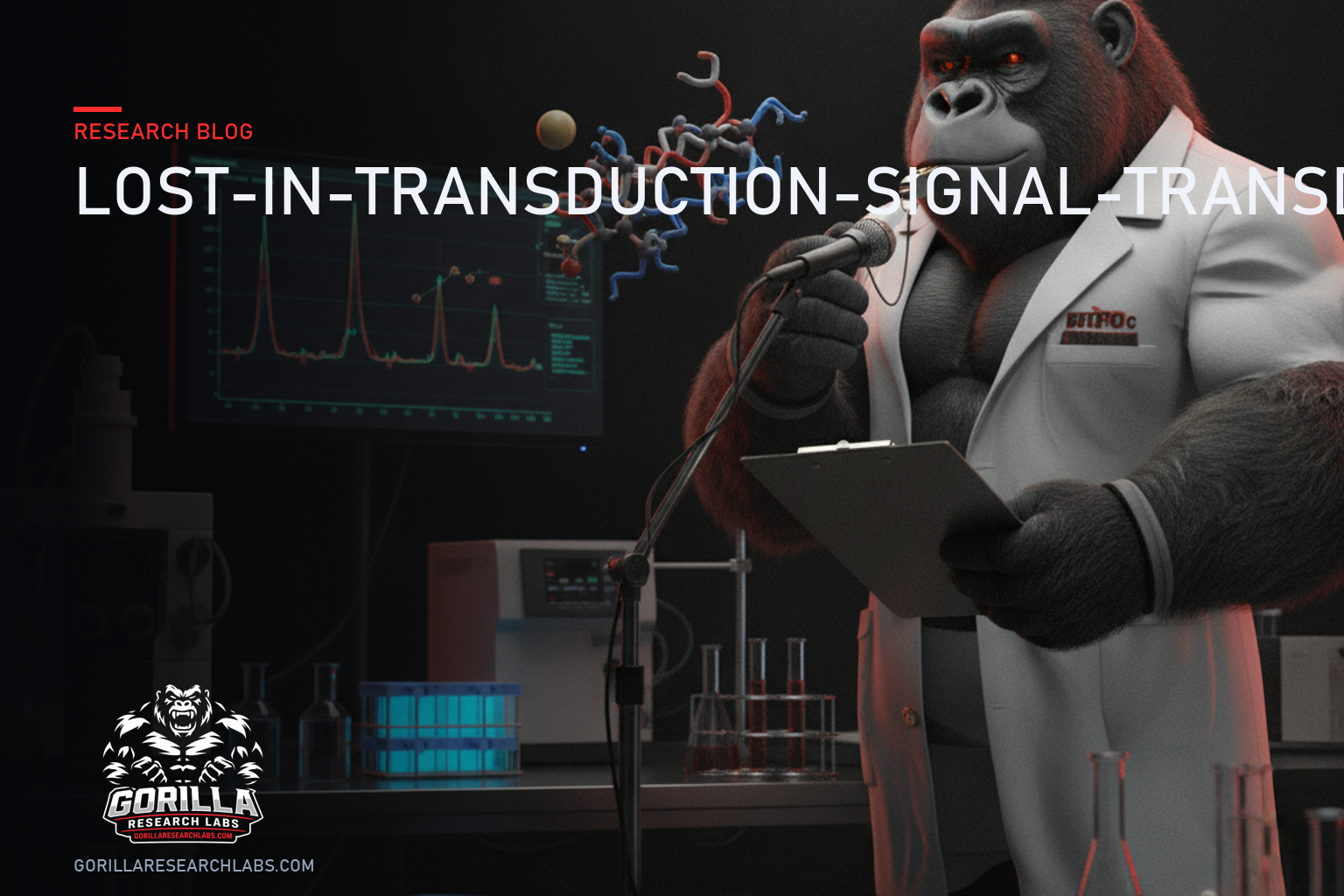
Picture a stadium the size of a cell. The crowd is roaring. A hormone sprints up to the outer wall, baton in hand, and skids to a stop. It cannot get in. The wall is a lipid membrane and there is no door. So how does the message get from out there to in here , all the way to the finish line where something actually happens? Enter the Gorilla professor, clipboard in one massive paw, whistle in the other. He leans into the mic: "Ladies and gentlemen, welcome to the greatest relay race in biology. This is signal transduction — and every leg of it matters."
The baton pass at the wall
The first runner never crosses the membrane. Instead, the signaling molecule slaps its baton into a receptor — a protein wedged through the wall like a turnstile. That handshake changes the receptor's shape. On the outside, nothing looks different. On the inside, everything just did. The message didn't travel through the wall; it got re-encoded on the far side. That is the whole trick, and it is the moment the crowd loses its mind. "Watch the receptor," the professor bellows. "It doesn't carry the runner in. It carries the idea of the runner in."
The cascade: where one becomes a thousand
Here is where a relay race turns into a stampede. That first intracellular baton pass wakes up a helper protein, which activates an enzyme, which spits out a flood of tiny messengers — think of them as second-string runners pouring onto the track by the thousands. These second messengers (molecules like cyclic AMP and calcium ions get the classic name-check) fan out across the whole cell at once. Each one taps the next runner. Enzymes switch on enzymes. Proteins flip other proteins from "off" to "on" like a row of light switches. This is the cascade , and its superpower is amplification : one lonely signal at the wall becomes an army inside. The professor calls it the play that turns a whisper into a stadium chant. • Reception — the outside signal binds its receptor and hands off the baton. • Transduction — the message is relayed and multiplied through a chain of molecular runners. • Response — the cell finally does the thing.
Crossing the finish line
All that sprinting has to add up to something you can measure. That's the response — the finish line where the cell changes behavior. Maybe a gene gets switched on and the cell starts building a new protein. Maybe a channel opens and ions rush across. Maybe the cell decides to divide, or move, or hold its position. Whatever it is, it's real, it's observable, and it started with a runner who never even made it through the door. "That," says the professor, flexing a bicep the size of a medicine ball, "is how a cell listens without ears and acts without hands."
Why the relay design is genius
Nature could have built a single giant molecule to do the whole job. It didn't — and the multi-runner relay is why. Splitting the work into legs gives cells three things a single sprinter never could: • Amplification — a faint external cue becomes a full-throated internal response. • Precision — each handoff is a checkpoint where the cell can speed up, slow down, or wave the runner off entirely. • Flexibility — the same opening leg can feed different finish lines depending on which runners are on the track that day. It's modular. It's tunable. It's a system a research team can actually study one leg at a time — which is exactly why signal transduction sits at the heart of so much molecular biology.
The professor's closing note
So the next time someone says a cell "responded" to something, remember there was a whole relay race behind that one word. A baton at the wall. A cascade of runners. A measurable finish. No runner crossed the membrane, yet the message arrived anyway — louder, faster, and multiplied. The Gorilla professor tucks the whistle away and grins. "Beautiful race. Same time tomorrow — there's always another signal at the gate." At Gorilla Research Insights, we're obsessed with these relays, because understanding how cells turn a signal into an action is where the real science begins. Educational content only. Nothing here is medical, therapeutic, or dosing guidance.
References
- NCBI Bookshelf — Molecular Biology of the Cell: Signaling
- PMC — Cell signaling pathways and receptor biology
Authoritative sources cited for research context. Research use only — not medical advice.