
Purity Is a Personality Trait: How to Interrogate a Reported 99% Result
Purity Is a Flex. Prove It.
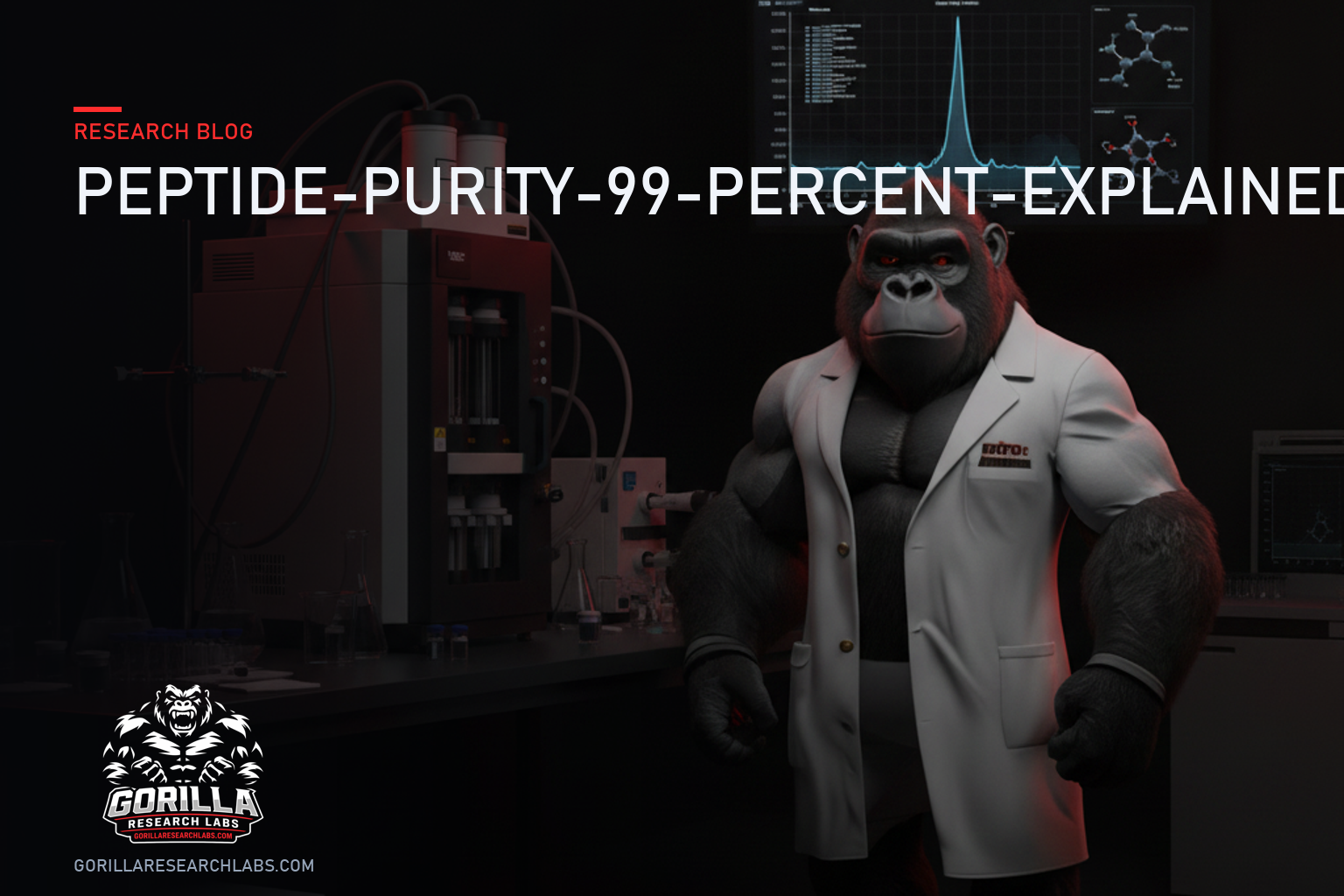
Picture our resident silverback professor at the squat rack. Charcoal fur, lab coat straining at the seams, red light glinting off a glowing DNA helix he's using as a chalk bar. Someone yells, "Bro, how much do you lift?" He doesn't answer with a number. He answers with a video , three witnesses, and a signed logbook. Because a claim without proof is just a rumor with good lighting. That, friends, is exactly how a serious lab treats peptide purity . A reported “99%” is not a vibe—and it is not self-explanatory. The professor wants the method, chromatogram, integration rules, sample identity, and lot linkage before anybody gets to brag.
So What Does "99% Purity" Actually Mean?
When a chromatogram reports 99% area purity, it generally means the main detected peak represents about 99% of the integrated peak area under that method’s conditions. It does not automatically mean 99% of the total vial mass is the intended peptide, nor does it establish identity, peptide content, sterility, endotoxin status, or the absence of compounds the method does not detect. The molecular gym still has blind spots. Here's the part that makes rigorous researchers twitch: purity is a spectrum, not a sticker. There's a real difference between: • Stated purity — a number printed on a label because someone typed it there. • Verified purity — a number backed by an actual analytical method, run on that actual batch. One of those is a personality trait. The other is a receipt. The professor only respects receipts.
Why 1% Can Wreck 100% of Your Reproducibility
You'd think a measly 1% wouldn't matter. But research isn't graded on "close enough." It's graded on reproducibility — the idea that if you run the same experiment twice, you get the same result. That only works if your inputs are consistent. Imagine two vials both labeled "same compound." One is genuinely 99% pure. The other is 90%, with a mystery grab-bag making up the difference. Run an experiment with each and get two different outcomes — congratulations, you now have a data ghost story with no ending. Was it the variable you were testing? Or was it the uninvited 10%? You can't tell. Your experiment just became unfalsifiable, which is a fancy word for "useless." This is why purity is a research-integrity issue, not just a chemistry one. Impurities are invisible confounders. They don't announce themselves. They just quietly ruin your ability to say "this result was caused by the thing I intended to study." Reproducible science demands boring, consistent, well-characterized inputs. Purity is how you get boring in the best possible way.
How the Pros Actually Verify (a.k.a. Show Your Work)
Verification is where the swagger meets the science. A credible purity claim is backed by a Certificate of Analysis (CoA) — the compound's report card. And the professor reads report cards like a scout reads game tape. He's looking for: • HPLC (High-Performance Liquid Chromatography) — separates detectable components under stated conditions and can report relative chromatographic peak area. One tall peak can be encouraging, but the method, detector, integration, and system suitability still matter. • Mass Spectrometry — can provide evidence consistent with an expected molecular mass. Identity conclusions depend on the method, tolerances, sample linkage, and interpretation; mass alone is not an all-clear siren. • Batch-specific data — a CoA for this lot, not a generic one photocopied since 2019. Every batch is its own athlete and earns its own numbers. See the pattern? Verify, then trust. Never the other way around. Trusting first and verifying later is how you end up citing a compound you can't vouch for in a paper you can't defend.
Purity as Personality
Here's the shareable truth the professor wants tattooed on every lab wall: anyone can claim strength; character is proving it on demand. A compound that shows up with clean chromatograms, batch-specific documentation, and mass-spec confirmation isn't just "high quality." It's trustworthy — and in research, trustworthy is the whole ballgame. Purity is a personality trait because it tells you how something behaves when nobody's checking. Does the number hold up under scrutiny? Does the paperwork match the vial? Is the same standard applied to every batch, not just the pretty ones? That consistency-under-pressure is the difference between data you can build on and data you have to apologize for. So the next time you see a reported “99%,” don't nod and move on. Do the professor thing: raise an eyebrow, ask for the COA, check the method and lot, and read the peaks in context. Verify before you trust. In the lab, purity is not a bragging right handed over by a headline. Now go read a Certificate of Analysis. The professor is watching. And yes, he is still doing curls with that DNA helix.
References
- National Center for Biotechnology Information — Peptides (StatPearls)
- PubMed — Therapeutic peptides: current applications and future directions
- PMC — High-performance liquid chromatography (HPLC) principles and practice
- U.S. FDA — Analytical Procedures and Methods Validation for Drugs and Biologics
- U.S. FDA — Q6A Specifications: Test Procedures and Acceptance Criteria
- NIH — Rigor and Reproducibility in Research
Authoritative sources cited for research context. Research use only — not medical advice.