
Inside a Real Research Lab: What Actually Happens Before a Vial Ships
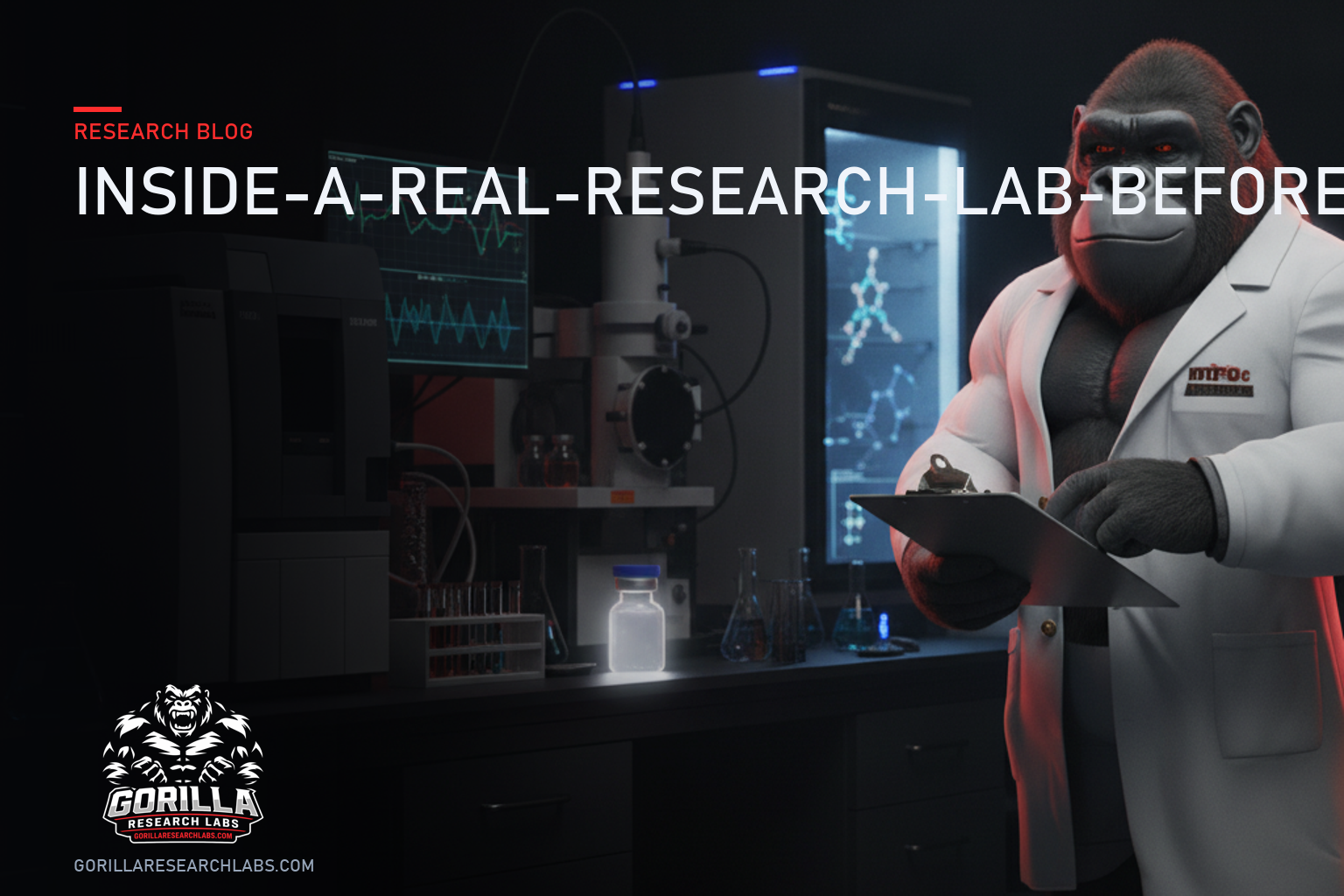
Grab a hard hat. The big guy is giving the tour.
Somewhere behind the glossy little vial you picture in your head, there is a room that hums. Fluorescent, cold, faintly obsessive. And standing in the doorway, sleeves of a lab coat straining against arms that have clearly never skipped a single day, is our resident silverback professor. He taps the clipboard against one massive palm and grunts a welcome. Translation: "You want to know what actually happens before a vial ships? Follow me. Touch nothing." Because here is the thing nobody puts on a landing page: the exciting part of laboratory research is not the vial. It is the paranoia. The good kind. The kind that turns "probably fine" into a documented, verified, boring-in-the-best-way certainty. Let's walk the floor.
Station one: synthesis, where "close enough" gets thrown out
First stop, the professor points a thick finger at the synthesis bench. This is where raw material becomes the actual compound, one carefully controlled reaction at a time. The goal is high purity, and purity is a jealous god. Trace contaminants, leftover reagents, the wrong byproduct sneaking in at half a percent, the whole batch is suspect. So the work is slow on purpose. Controlled temperatures. Measured additions. Instruments that measure things far past the point a human eye could ever notice. The gorilla nods approvingly at a chromatography readout, because a clean peak on that screen is, to a research operation, roughly what a perfect deadlift is to him. Beautiful. Earned. Non-negotiable.
Station two: the cold rooms (mind the goosebumps)
Next he shoulders open a heavy door and a wall of cold air rolls out. Storage. Because making something pure is only half the job, keeping it that way is the other half. Many research materials are sensitive little divas, they degrade if you look at them warm for too long. That means controlled storage with actual discipline behind it: • Temperature control that is monitored, not vibes-based, often with logging that would make an accountant weep with joy. • Separation and labeling so nothing gets confused with its neighbor, ever. • Alarms and backups for the day a freezer decides to have a personality crisis at 3 a.m. The professor thumps the freezer door twice, gently, like a coach patting a reliable athlete. This machine has one job and it does not miss.
Station three: documentation, the least glamorous superhero in the building
Now we reach the part people love to skip and the professor absolutely will not let you. Paperwork. Well, mostly digital, but you get it. Every batch has a story, and in a real research operation that story is written down: what went in, when, at what conditions, who handled it, where it went next. This is chain of custody, and it is the unsung hero of the whole tour. It is the difference between "trust us" and "here is the record, read it yourself." The big guy respects documentation because documentation never brags and never lies. It just quietly proves you did the work. He taps the log one more time. The gesture means this is where credibility actually lives.
Station four: quality control, the final boss
Last stop, and the professor cracks something like a smile. Quality checks. Before anything is cleared, it gets tested against a specification, and independent verification confirms identity and purity. A batch that passes earns its Certificate of Analysis, the receipt that says we checked, and here are the numbers. A batch that fails? It does not get quietly nudged out the side door. It gets stopped. That is the entire point. A serious lab is defined less by what it ships and more by what it refuses to.
So, what actually happens before a vial ships?
A lot of small, unglamorous, deeply intentional steps stacked on top of each other until "we think this is good" becomes "we can show you exactly why this is good." Synthesis, storage, documentation, testing. Four stations, zero shortcuts. The professor peels off his gloves, cracks his knuckles like distant thunder, and points you back toward the exit. The tour is over. The standard is not. In laboratory research, the vial is just the trophy, the process is the sport, and around here, we train like it. For research use only. This piece describes laboratory operations and quality practices, not usage guidance of any kind.
References
- PMC — Solid-phase peptide synthesis: an overview
- U.S. FDA — Q6A Specifications: Test Procedures and Acceptance Criteria
- PMC — High-performance liquid chromatography (HPLC) principles and practice
- PMC — Stability, storage and cold-chain handling of peptides and proteins
- U.S. FDA — Data Integrity and Compliance With Drug CGMP (Guidance)
Authoritative sources cited for research context. Research use only — not medical advice.