
Meet the Professor: Why a 900-lb Gorilla Runs a Peptide Lab
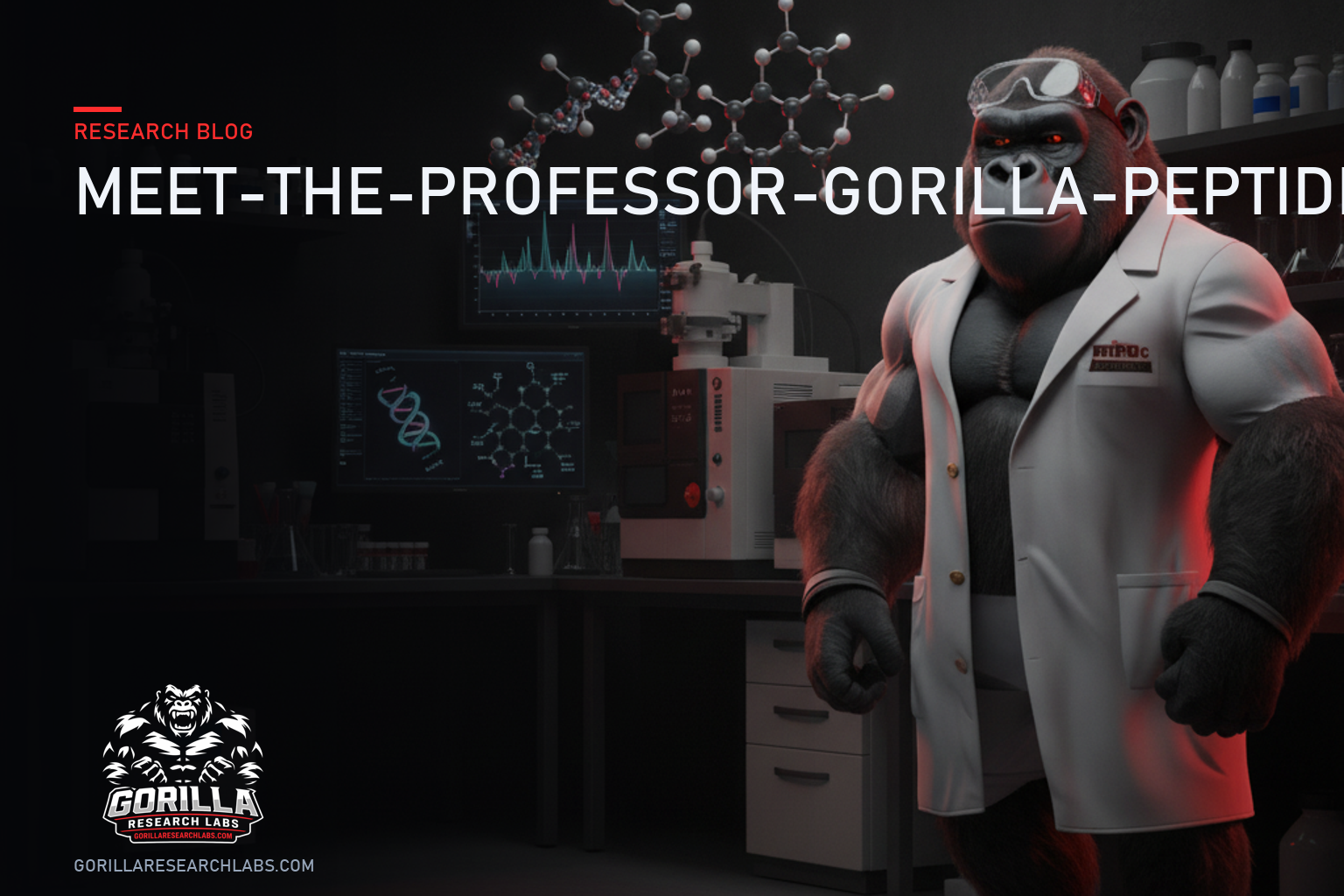
Push open the door. Mind the gorilla in the lab coat.
He is nine hundred pounds of charcoal-grey silverback. His forearms are the size of fire extinguishers. He is wearing safety goggles, a lab coat that gave up on the buttons somewhere around the third one, and the calm expression of someone who has read the paper you're about to misquote. This is the Professor, and he runs the lab around here. We know. A gorilla. In a research facility. It sounds like the setup to a joke. But stay a minute, because the Professor is the best plain-language science teacher you'll meet, and he's about to walk you through the one question that matters on this whole site: what actually is a research peptide?
The 30-second version, Professor-approved
A peptide is a short chain of amino acids. Amino acids are the same little building blocks that link up into the proteins running every process in a living cell. String a handful of them together in a specific order and you get a peptide: small, precise, and shaped to do exactly one thing. A research peptide , then, is one of these chains made to a high level of purity so that scientists can study it in a controlled setting. That last part is the whole point. These are laboratory reference compounds, produced and characterized for investigation — not consumer goods. The Professor gets very still when people forget that, so we won't.
Why scientists care about tiny chains
Cells talk to each other constantly, and a lot of that conversation runs on peptides. They're the notes passed in class, the door knocks, the little keys that fit little locks. When a researcher wants to understand how a biological system behaves, a well-defined peptide is one of the cleanest ways to ask a precise question and get a readable answer. The Professor's lab is set up to study things like: • Signaling pathways — how a message travels from one point in a system to another, and what changes along the way. • Receptor interactions — how a specific molecule fits (or doesn't fit) a specific receptor, like testing keys against a lock. • Cellular responses — what a system does after it gets a signal, measured under controlled laboratory conditions. Notice what every one of those has in common: they're questions, studied in a lab. Nobody in this building is prescribing anything. They're taking notes.
So why a gorilla, exactly?
Fair. Here's the honest answer. We wanted a mascot that captured two things at once, and most mascots only manage one. The first thing is strength you can see . Purity is muscle. When a compound is well-made and well-characterized, your data stands up straight. When it isn't, everything downstream gets wobbly. A silverback is what "sturdy" looks like when it walks into a room. The second thing is the part people underestimate: gorillas are ferociously smart . Patient, methodical, curious, and completely unbothered by whoever's shouting. That's the "strongest brain in the jungle" energy — not the loudest voice, the steadiest one. A science-first, research-use-only brand doesn't want a hype man. It wants the calm giant who reads the label twice and shows his work.
Your lab tour guide, going forward
This post is the welcome mat for the entire INSIGHTS blog, and the Professor is your guide for all of it. When we dig into a specific class of compounds, unpack a confusing bit of terminology, or explain why a certificate of analysis is the least boring document in the building, he'll be the one holding the clipboard. His house rules are refreshingly short: • Plain language, always. If a nine-hundred-pound gorilla can explain it without jargon, so can we. • Research context, always. Everything here is written for study and investigation. For research use only. No exceptions, no winking. • Curiosity over hype. The interesting stuff is the actual science. We'll never bury it under buzzwords. So consider yourself introduced. The goggles are on the hook by the door, the Professor already knows more about signaling pathways than the internet's comment section combined, and the whole INSIGHTS blog is basically him, pacing the lab, ready to make the small-and-precise world of research peptides genuinely fun to understand. Grab a coffee. Tour starts whenever you're ready. Just don't touch the centrifuge — that one's his.
References
- National Center for Biotechnology Information — Peptides (StatPearls)
- PubMed — Therapeutic peptides: current applications and future directions
- U.S. FDA — Q6A Specifications: Test Procedures and Acceptance Criteria
- PMC — High-performance liquid chromatography (HPLC) principles and practice
- NCBI Bookshelf — Molecular Biology of the Cell: Signaling
- PMC — Cell signaling pathways and receptor biology
Authoritative sources cited for research context. Research use only — not medical advice.